NAVIGATING PAYMENT RISKS IN VIETNAM'S HOME DECOR SOURCING
Safeguarding your working capital when sourcing high-volume bamboo, rattan, or acacia wood products from Vietnam requires a precise balance of financial risk between Telegraphic Transfer (T/T) and Letter of Credit (L/C). When importing hand-woven home decor, global procurement teams face two critical hurdles: maintaining cash flow flexibility and ensuring material quality consistency. Natural materials like water hyacinth, seagrass, and bamboo are highly sensitive to moisture and require specialized drying and treatment processes. If you pay too much capital upfront, you lose financial leverage; if you pay too late, the manufacturer cannot secure high-quality raw materials during the harvest season. How do you resolve this operational tension?
The answer lies in selecting a payment structure that matches your transaction size, supplier compliance history, and risk tolerance. For global retailers, understanding how these mechanisms function in the Vietnamese banking system is key to preventing costly supply chain disruptions. Vietnamese banks operate under international standards, but local customs and processing times can vary based on the bank selected. By establishing clear payment milestones, you can protect your business from quality discrepancies and delivery delays.
To help you evaluate your options, we have compiled a direct comparison of how these payment structures perform under standard B2B export conditions. This matrix serves as a strategic starting point for procurement managers planning their next container allocation:
|
Operational Metric
|
Telegraphic Transfer (T/T)
|
Letter of Credit (L/C)
|
|
Ideal Order Value
|
Small to medium orders (under $50,000 USD)
|
High-volume container shipments (over $100,000 USD)
|
|
Transaction Cost
|
Low ($20 - $50 flat fee per transfer)
|
High (1% - 3% of the total contract value)
|
|
Processing Speed
|
1 - 3 business days for global clearance
|
2 - 4 weeks for bank verification and issuance
|
|
Risk Allocation
|
Balanced when structured as a 30/70 split
|
Highly secure for both buyer and manufacturer
|
|
Documentation
|
Flexible, managed directly between parties
|
Rigid, strictly scrutinized by international banks
|
Deconstructing Telegraphic Transfer (T/T): The Balanced 30/70 Model
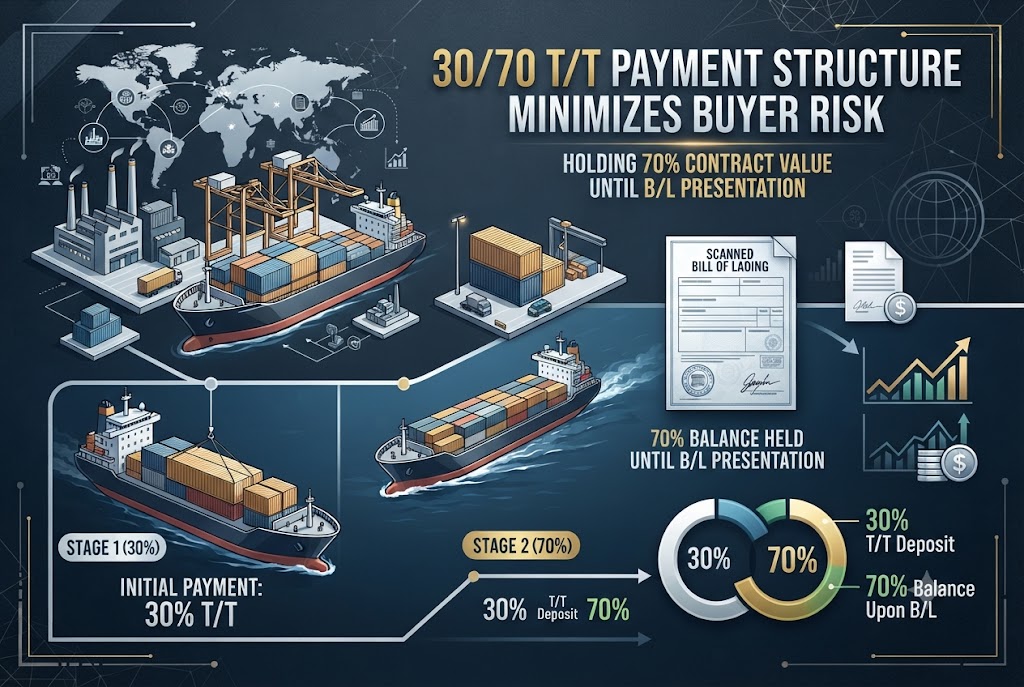
The standard 30/70 T/T split is the most cost-effective payment mechanism for verified suppliers, where a 30% advance deposit triggers production, and the 70% balance is paid only against the presentation of scanned shipping documents. This 30% deposit is crucial because it allows the factory to buy raw materials immediately. For instance, securing certified FSC acacia wood or premium bamboo in bulk requires upfront cash to lock in favorable raw material prices. The remaining 70% is held until we provide a scanned Bill of Lading (B/L) showing the container is loaded and on its way.
Why is this setup highly secure for you? It ensures that your cash is never fully exposed before the goods are physically shipped. By holding the 70% balance, you maintain complete leverage over the manufacturer until the shipping line confirms receipt of the cargo. This structure also incentivizes the factory to meet the agreed-upon lead times, as their final payment is directly tied to the dispatch of the goods. For high-capacity operations, this cash flow model supports continuous manufacturing without straining the supplier's working capital.
Consider how this payment structure directly impacts manufacturing efficiency and capital safety in real-world operations:
- The Challenge: A European home decor retailer needed to source 3 x 40ft HQ containers of custom bamboo storage baskets with strict BSCI compliance.
- The Solution: By utilizing a 30/70 T/T structure, they paid a $15,000 USD deposit to secure raw materials during a high-demand harvest season, preventing material price hikes.
- The Result: Production was completed in 45 days, and the remaining balance was only wired after they verified the scanned Bill of Lading and phytosanitary documents, ensuring zero quality disputes.
To execute this safely, always ensure the contract specifies that the 70% balance is payable only after a third-party quality inspection report is approved. This prevents the factory from shipping defective goods and holding your deposit hostage.
MASTERING LETTER OF CREDIT (L/C) FOR HIGH-VOLUME HOME DECOR PROCUREMENT
A 100% Irrevocable Letter of Credit (L/C) at Sight offers the highest financial security for large-scale, multi-container shipments by shifting the payment guarantee from the buyer to a reputable issuing bank. Under this structure, the manufacturer only receives payment when they present a perfect set of documents to the bank. These documents typically include a clean on-board Bill of Lading, a Phytosanitary Certificate, a Certificate of Origin (Form A or EUR.1), and a commercial invoice. This guarantees that your money is not released unless the factory meets every single contractual and regulatory milestone.
Are there any hidden traps with this method? Yes, banks operate strictly on documents, not physical goods, meaning even a single typographical error can freeze your funds or delay customs clearance. For natural fiber exports like rattan and water hyacinth, strict import standards require precise phytosanitary and fumigation documents. A minor discrepancy in the consignee name or container number can lead to a bank rejecting the presentation, causing weeks of delays and expensive demurrage fees at the port of destination.
To avoid costly delays, ensure your sales contract explicitly defines the following document standards:
- Clean On-Board Bill of Lading: Confirms the exact date and condition of the cargo loaded at Vietnamese ports like Hai Phong or Da Nang.
- Phytosanitary Certificate: Essential for natural materials (rattan, seagrass, water hyacinth) to prove compliance with international pest control standards.
- Fumigation Certificate: Verifies that wood and fiber products have undergone professional heat or chemical treatment to prevent mold during ocean transit.
- Certificate of Origin (C/O): Allows you to claim preferential tariff treatments under active trade agreements like the EVFTA or CPTPP, reducing your import duties.
By requiring these documents under an L/C, you enforce compliance with international regulatory bodies before a single dollar leaves your bank account. This is particularly critical for high-end interior design projects where material certification is non-negotiable.
STRATEGIC RISK MITIGATION: CHOOSING THE OPTIMAL TERMS FOR YOUR SUPPLY CHAIN
Deciding between T/T and L/C depends on your transaction history, order volume, and the complexity of the custom (OEM/ODM) designs being manufactured. To optimize your supply chain’s financial performance, use a clear decision matrix. For new suppliers or massive first-time orders exceeding $100,000, always insist on an Irrevocable L/C at Sight to eliminate non-performance risks. For established partnerships with compliant manufacturers who carry BSCI, SMETA, and FSC certifications, transitioning to a T/T 30/70 or even a deferred T/T 60-day term will significantly reduce your operational costs and speed up production.
How do you mitigate risk when transitioning to T/T? You must conduct rigorous factory audits and rely on third-party quality inspections before the container is sealed. This ensures that the products meet the required moisture levels (typically under 12% for acacia wood and under 18% for bamboo) before they are shipped.
Here is your strategic payment decision matrix to guide your procurement planning:
- Order Value: Use T/T for orders under $50,000 to avoid high bank fees; use L/C for orders over $100,000 to protect capital.
- Supplier Compliance: Verify if the supplier has international audits (BSCI, SMETA, FSC) before sending any T/T deposits.
- Customization Level: OEM/ODM designs using specialized molds require at least a 30% T/T deposit to cover tooling and prototype costs.
By matching your payment terms to these operational variables, you protect your business from supply chain disruptions while fostering a sustainable, long-term manufacturing partnership.
This article is authored by Thong Nguyen – Co-owner & Sales Director at Ngoc Dong Ha Nam Co., Ltd. With 25+ years of experience managing and operating manufacturing facilities for export housewares and handicrafts, we specialize in providing high-quality bamboo, rattan, water hyacinth and natural acacia wood manufacturing solutions for global retail partners.
FREQUENTLY ASKED QUESTIONS
What is the safest payment method for a first-time order with a Vietnamese supplier?
For first-time orders exceeding $100,000 USD, an Irrevocable Letter of Credit (L/C) at Sight is the safest method as it guarantees payment only upon presentation of compliant shipping documents. For smaller trial orders, a 30/70 T/T split is highly recommended.
Why do Vietnamese suppliers require a 30% deposit for T/T payments?
The 30% deposit is used to secure raw materials like bamboo, rattan, and acacia wood immediately, locking in material costs and initiating the labor-intensive handcrafting process.
What documentation is critical for L/C payments when importing home decor from Vietnam?
Critical documents include a Clean On-Board Bill of Lading, Commercial Invoice, Packing List, Certificate of Origin, and a Phytosanitary Certificate to verify that natural fibers are free of pests and moisture.
How can B2B buyers reduce transaction costs associated with Letters of Credit?
Buyers can reduce costs by consolidating multiple smaller orders into single high-volume shipments or by transitioning to T/T terms once a trusted, audited relationship is established with the manufacturer.