INTRODUCTION: THE CHALLENGE OF SCALING COMPLEX HOME DECOR DESIGNS
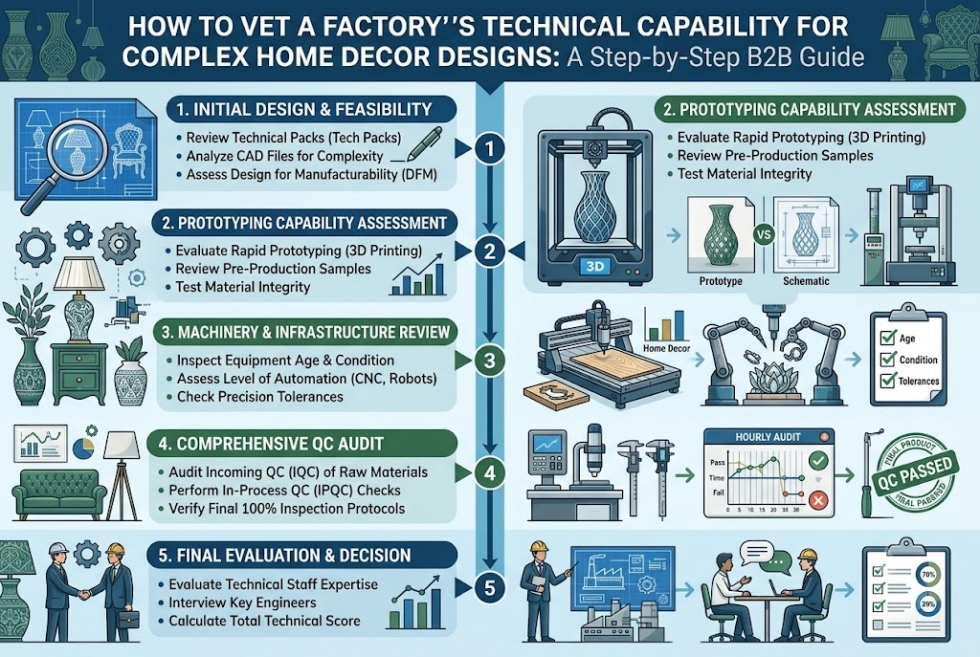
Vetting a factory's technical capability for complex home decor designs requires a systematic evaluation of their prototyping precision, engineering expertise, machinery standards, and artisan craftsmanship. For global B2B buyers, sourcing managers, and interior designers, translating a highly creative, multi-material concept into a scalable, high-volume production run is one of the most challenging phases of the supply chain. Without a rigorous vetting process, complex designs involving natural materials often suffer from structural failures, high defect rates, and costly shipping delays.
As global consumer demand shifts toward sustainable luxury, designs have become increasingly sophisticated. Modern home decor frequently blends rigid materials like plantation-grown Acacia wood with flexible, hand-woven natural fibers such as rattan, bamboo, seagrass, and water hyacinth. Scaling these products requires more than just traditional handcrafting; it demands a seamless marriage of modern engineering and heritage craftsmanship. This guide provides a step-by-step blueprint to help you audit and verify a manufacturer's technical capabilities before signing your next purchase order.
PREREQUISITES: WHAT TO PREPARE BEFORE INITIATING A TECHNICAL AUDIT
Before vetting a factory, you must prepare a comprehensive Tech Pack containing detailed 3D CAD drawings, exact material specifications, tolerances, and clear compliance requirements. A technical audit is only as effective as the parameters you set; without clear benchmarks, it is impossible to objectively measure a factory's capability. By providing a standardized technical package, you establish a baseline that separates highly capable OEM/ODM manufacturers from low-tier workshops.
A professional Tech Pack should move beyond simple aesthetic sketches. It must define the exact engineering boundaries of your design. The table below outlines the critical differences between a standard purchase inquiry and a robust Technical Tech Pack required for complex designs:
|
Document Component
|
Standard Purchase Inquiry (Basic)
|
Technical Tech Pack (Advanced)
|
|
Design Files
|
2D PDF sketches or reference photos
|
3D CAD files (STEP/IGES) & 2D technical drawings with multi-angle orthographic views
|
|
Material Specs
|
"Acacia wood and woven seagrass"
|
Botanical species (e.g., Acacia mangium), weave style (e.g., basketweave), and fiber moisture content (8-12%)
|
|
Tolerance Levels
|
No tolerances specified
|
Defined allowable deviations (e.g., ±1mm for wood joinery, ±5mm for hand-woven components)
|
|
Finishing & Testing
|
"Water-resistant finish"
|
Specific NC/PU lacquer coating codes, lead-free certifications, and salt-spray test requirements
|
Step 1: Evaluate Prototyping Precision and CAD-to-Sample Translation
Evaluating prototyping precision involves testing how accurately a factory translates your 3D CAD models into physical samples while maintaining structural integrity. The prototyping phase is the first true test of a manufacturer's engineering department. A premium factory does not merely copy a drawing; their in-house design team will analyze the structural load, joint stress points, and material compatibility to optimize the design for mass production.
When auditing this step, request a "Golden Sample" and ask the factory to explain their sample-making workflow. Pay close attention to how they handle complex mixed-material interfaces. For example, when joining a rigid Acacia wood frame with a hand-woven rattan panel, the factory must calculate the natural expansion and contraction of both materials. Ask the technical director: How do you account for material shrinkage during seasonal climate shifts? A factory with high technical capability will immediately showcase their engineered expansion joints or specialized framing techniques.
Step 2: Inspect Machinery, Tooling, and Manufacturing Infrastructure
Inspecting a factory's machinery requires verifying their CNC routing capabilities, precision wood-drying kilns, and specialized jig tooling for complex geometric shapes. While handmade aesthetics are highly prized in home decor, modern industrial machinery is vital to achieving consistency and structural durability across thousands of units. Hand-carving and manual cutting cannot match the micron-level precision required for complex interlocking joinery.
During your physical or virtual factory tour, prioritize auditing the following machinery and infrastructure:
- Moisture Control & Kiln Drying: For wood and bamboo, check if the factory operates computerized kiln dryers. Wood must be dried to an optimal moisture content of 8% to 12% to prevent warping, cracking, or mold during transit and storage.
- CNC Machining Centers: Multi-axis CNC routers ensure that complex wooden components, curves, and cutouts are identical from the first piece to the ten-thousandth.
- Custom Jigs and Tooling: High-quality manufacturers design and build custom metal assembly jigs. These jigs lock components in place during gluing, pressing, or weaving, ensuring perfect geometric alignment and zero skewing.
Step 3: Assess Artisan Skillsets and Multi-Material Integration
Assessing artisan skillsets requires verifying the weavers' and woodworkers' ability to seamlessly integrate natural fibers like rattan, water hyacinth, and seagrass with rigid wooden or metal frames. The finest machinery is useless without skilled artisans who understand the unique physical properties of natural materials. In Vietnam, the integration of heritage weaving techniques with modern industrial design is a highly specialized trade found primarily in dedicated craft regions.
To evaluate this capability, observe the weavers on the factory floor. Look for consistency in weaving tension, the seamless hiding of fiber ends, and the structural reinforcement of corners. In high-end B2B manufacturing, artisans must work closely with the engineering team. For instance, when weaving water hyacinth over a powder-coated iron frame, the artisans must ensure the tension does not warp the metal frame, which would prevent the final product from sitting flat on a surface.
Step 4: Audit Quality Control (QC) Protocols and Tolerance Standards
Auditing QC protocols involves checking the factory's in-line and pre-shipment inspection checklists for structural tolerances, moisture levels, and joint stability. Technical capability is not just about making a beautiful sample; it is about maintaining that standard across an entire production run. A factory with robust technical capabilities will have a dedicated, independent QC department operating under ISO 9001 or equivalent standards.
Ask to review their QC logs for previous production runs of similar complexity. A reliable manufacturer should enforce strict tolerance thresholds. The table below illustrates the industry-standard QC tolerance limits that professional factories apply to natural home decor:
|
Inspection Criteria
|
Acceptable Tolerance Limit
|
Testing Method / Tool
|
|
Moisture Content (Wood/Bamboo)
|
8% – 12% (destination market dependent)
|
Pin-type or pinless digital moisture meter
|
|
Dimensional Deviation
|
±1.5 mm for wood; ±5.0 mm for hand-weaving
|
Digital calipers and standardized measuring jigs
|
|
Load-Bearing Capacity
|
Zero structural deformation under target load
|
Static weight load testing in QC lab
|
|
Adhesive & Coating Bonding
|
Grade 4B or 5B (no peeling)
|
Cross-cut tape adhesion test (ASTM D3359)
|
Step 5: Verify International Compliance and Sustainability Certifications
Verifying compliance requires auditing the factory's active certifications, including FSC for sustainable wood sourcing, and BSCI or SMETA for social responsibility. Technical excellence must be backed by ethical and sustainable operations. Major global retailers and design houses cannot risk supply chain disruptions or brand damage due to illegal logging or poor working conditions. A factory's ability to maintain these certifications is a strong indicator of their overall organizational discipline and technical management.
When reviewing certifications, ensure they are currently active and registered under the factory's legal name. The Forest Stewardship Council (FSC) certification guarantees that the Acacia wood or bamboo used in your designs is sourced from responsibly managed forests. Social compliance audits, such as the Business Social Compliance Initiative (BSCI) or Sedex Members Ethical Trade Audit (SMETA), prove that the factory maintains safe working environments, fair wages, and ethical labor practices—factors that directly correlate with lower worker turnover and higher product quality.
CONCLUSION: SECURING A RELIABLE TECHNICAL PARTNERSHIP
Successfully vetting a factory for complex designs transforms your supply chain from a transactional relationship into a strategic partnership built on shared technical expertise and sustainable execution. By systematically auditing prototyping precision, machinery infrastructure, artisan skills, QC protocols, and international compliance, you mitigate production risks and protect your brand's reputation. When you partner with a manufacturer that possesses both advanced engineering capabilities and a deep heritage in natural materials, even the most complex design visions can be brought to life flawlessly on the global stage.
At Ngoc Dong Ha Nam, we combine over two decades of manufacturing heritage with state-of-the-art technology to deliver premium, sustainable home decor solutions. Our integrated production facilities, skilled artisans, and strict compliance standards ensure that your complex designs are manufactured to the highest international quality. Contact our engineering team today to discuss how we can bring your next product collection to life.
This article is authored by Nguyen Huy Thong – Co-owner & Sales Director at Ngoc Dong Ha Nam Co., Ltd. With 25+ years of experience managing and operating manufacturing facilities for export housewares and handicrafts, we specialize in providing high-quality bamboo, rattan, water hyacinth and natural acacia wood manufacturing solutions for global retail partners.
FREQUENTLY ASKED QUESTIONS
What is the most critical factor when manufacturing mixed-material home decor?
The most critical factor is moisture control and managing the different expansion rates of materials. Wood, bamboo, and natural fibers expand and contract differently based on environmental humidity, requiring engineered joints and precise kiln drying (8-12% moisture content) to prevent warping or cracking.
How can I verify a factory's technical capability remotely?
You can verify technical capability remotely by requesting a detailed Tech Pack review, conducting a live virtual factory tour to inspect their CNC machinery and kiln dryers, requesting video demonstrations of their custom assembly jigs, and auditing their active FSC, BSCI, or SMETA certification documents.
Why is FSC certification important for complex wooden home decor?
FSC certification ensures that the wood or bamboo used is sourced from responsibly managed forests. It is legally required by many global retailers to comply with international timber regulations (like EUTR and Lacey Act) and guarantees supply chain transparency.
What dimensional tolerance should I expect for hand-woven products?
For hand-woven components using natural materials like seagrass or rattan, an acceptable dimensional tolerance is typically ±5.0 mm. For precision-machined wooden parts or joinery, the tolerance should be much tighter, around ±1.5 mm.